Recreation,tourist,travel,Washington,Mt. St. Helens,Mt. Rainier,forest,fishing ,hunting,camping,hiking,steelhead,salmon,trout,deer,elk,bear,mushroom,logging,White Pass Highway Shopper Newspaper,environment,volcano,U. S. Forest Service,Gifford Pinchot National Forest,Wenatchee National Forest,tourism ,events ,Packwood,Morton,Randle,Naches

Weekly current recreation report covering all outdoor activities including fishing, hunting, hiking, camping, skiing, mushroom, berry and firewood gathering around Mt. St. Helens, Mt. Rainier and Mt. Adams in the Cascade Range forests along the White Pass Highway in southwest Washington State.

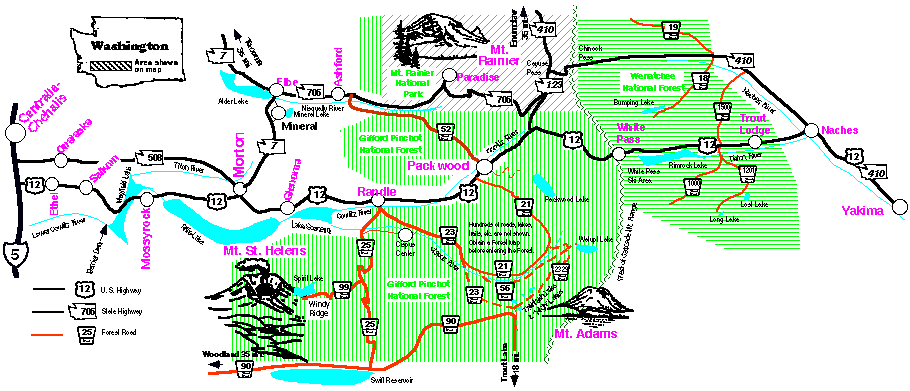
See a map showing our area here:

Important Note: This page is updated weekly. If this page produced by your browser is out of date, give your menu command "Reload Source" or equivalent. In seconds, your browser will then come to my server and get the current version. Sadly, some browsers refuse to update on command. If yours won't, use another browser. Thanks!

E-Mail: outdoors@highwayshopper.com Please phone or snailmail anything urgent or especially important.

Recreation Report from Shopper
for February 3, 2010

Submitted by Dave Bunting, Editor.

Here are the current Fishing Prospects as predicted by the Washington Department of Fish and Wildlife

Here are the Washington State Spring Reports of Fish Stocked, Updated Weekly

Here are the Washington State Spring Plans for Fish to be Stocked in this year

See the guide listing resorts, restaurants, motels and businesses serving every tourist need in this beautiful recreational area!

Headlines


Quick clicks to our various areas:

* Info for ALL of Shopper CountrySnow & Pass Conditions, Sunrise & Sunset, General Fishing Seasons

* Lower Cowlitz Fishing
* Mt. St. Helens
* Westside-Packwood & Randle Area Fishing, Hunting, Forest Roads, Campgrounds, Trails, Permits, Firewood, Mushrooms, Permits, Books, Packwood Ranger Station, Randle-Cowlitz Valley Ranger Station
* Mt. Rainier National Park
Visitor Centers, Park Roads, Campgrounds, General Park Info
* Eastside-Naches Area
Fishing, Hunting, Forest Roads, Campgrounds, Trails, Permits, Firewood, Mushrooms, Permits, Books, Naches Ranger Station Info
* General Information for All Areas including weather forecasts, El Niño reports, pollen forecasts, etc.

* Elsewhere in Washington

* Bristol Bay Sockeye Run

* Lynx Hair Controversy

Information for all of Shopper Country

Snow

Snow- Last weekend the snowline, above which snow was standing on the ground, was about 3,000 to 3,500 feet elevation both westside and eastside. At elevation 4,500 feet such as White and Cayuse Passes, Bumping Ridge and Sawmill Ridge snow was three to five feet deep. At elevations of 5,000 to 6,000 feet westside, such as at Paradise and Chinook Pass, snow was generally five to nine feet deep, but farther over on the eastside at Green Lake and Lost Horse there were only about three to four of snow.

White Pass Ski area reports Monday, Feb. 1 at 7 pm: Base 32° & 62 inches, Summit 27° and 75 inches, weather beautiful, mostly clear, trace new, light snow likely on Tuesday. Ben Turnin says, “Run of the day is a big serving of Poma Bowl - it's extra spicy!”


Snow Depths Jan. 25

Place                 Elev.        Ft.

Packwood          1,000          0

Skate S*P          1,500          0

Johnson S*P      2,400          0

Palisades            2,500          0

Rd. 21 MP 10.4  2,900        1/2

Orr Ck S*P        3,000          0

Hwy 12 Dip       3,100          0

Rd. 5603 MP1.6 3,500        1/2

Viewpoint          3,700        1/2

KnuppenbergLk   4,300          3

Crystal Lodge     4,400          4

Potato Hill         4,500          5

White Pass         4,500        3-5

Cayuse Pass       4,700          5

Morse Lake        5,400          8

Paradise             5,500          9

Pigtail Peak        5,900          6

Crystal Top        6,300          6

Corral Pass         6,000          4

Green Lk            6,000          4

Lost Horse         5,000          3

Sawmill Ridge    4,700          6

Bumping Rdg     4,600          5

Dog Lk              4,200          3

E Slide Bottm    3,600        1/2

Rimrock Lk        3,000        1/2

Rimrock Retrt     2,300          0

Oak Ck Game     1,700          0

Naches               1,500          0

Sno*Parks see below under Westside.

Be prepared; keep your vehicle winter-ready: antifreeze, fan belts, battery, wiper blades, and washer fluid. Load the Ten Essentials- the list is run periodically in the Shopper.

The three-month outlook for Feb.-Apr. is for warmer temperatures and less precipitation than in average years.

Highway Conditions

• White Pass Highway US 12 at 7 pm last Monday Feb. 1, was bare and wet with no tire restrictions. Weather was overcast skies at 34°. Call 511 for update.

No closure is predicted this week.

• Cayuse Pass Hwy. 123 and Stevens Canyon Road and Chinook Pass Hwy. 410 from Morse Ck. to Crystal jct. are closed for the winter.

The Sky

Sun and Moon Rise/ Set:

Sun Wed. 2/3     7:31am/ 5:17pm

 Moon 73% waning, high 3:56am

Sun Tue. 2/9 7:22am/ 5:26pm

 Moon 15% waning, high 9:05am

On press day Jan. 27 we are 37 days past the shortest day of the year on Dec. 21 and the days now are about 72 minutes longer!

We’re also about 38 days past the average coldest day of the year. The lowest daily average temperature in Packwood is 35° and occurs on Dec. 26; in Yakima it is 27° and occurs on Dec. 28.

Fishing

General Lakes, Ponds and Reservoirs Fishing Season is open year-round. However many of the most popular large "traditional" lakes are CLOSED to fishing from Nov. 1 until the last Saturday in April.

General Fishing Season on most Rivers, Streams and Beaver Ponds is CLOSED from Nov. 1 through May 31.

However very many waters have seasons different from the above so read your regulation pamphlet!

Fort Borst Park Pond- 3,029 catchable-size rainbows were planted on Dec. 28. Remember that this pond is open only to juveniles under 15 years old.


Lower Cowlitz Fishing

On the lower Cowlitz below Mayfield Lake, fishing seasons for salmon, trout and other species are open in various months, but are too complex to report in detail here; read your regulations.


Marshall & Tracey Borsom at Fish Country Inc., Salkum, report,

“As of Monday, Feb. 1, the fishing on the Cowlitz River has been better this last week, but still not red hot.  We think another push of steelhead came in as the ones that were caught were chrome bright.  See the picture of Kenny Norman (our 2nd place derby winner) with his 15 lb. 10 oz. nice steelhead caught down by Blue Creek. Way to go, Kenny!  The guys using jig and bobber seem to be doing good as well as the night guys glow balling.  Barrier Dam has still been very slow with only a few caught here and there.  We did hear of some nice springers caught in the lower river by Castle Rock.  Looks like our springer run is on it's way!!!

“We heard the fishing on Mayfield Lake this week has been pretty slow.  Riffe Lake has also been slow as the water level is really low.  We had a group of people go and fish Swofford Pond, but didn't hear anything back of how they did.

“Well, our steelhead derby is officially over.  First place went to James Jennings with a 16 lb. 13 oz., second to Kenny Norman with a 15 lb. 10 oz. and third to Jerry Menge with a 13 lb. 15 oz. - all very nice steelhead.  Thank you to everyone who participated.

“Hope you all have a nice week - the weather is going to be nice, so take someone fishing!!!”


Karen Glaser, Barrier Dam Campground, Salkum, reported last week:

“Fishing on the Cowlitz is still going about fair. The pressure has let up quite a bit. Most of the pressure is down at Blue Creek. On the weekends there are a few people up here at Barrier. They are working hard for the fish. Some are getting them, some aren’t. A lot of the guys are still waiting for that second run to show, which is usually in mid to late February. So it is a little early yet. 

“Those that are putting in the time are getting some nice fish. I had a couple of guys in here the other day that each had one. And there was the gentleman that got two fish, so you just have to work for them this time of year.

“They dropped the water down to 8,700.  If it will stay there or not I really couldn’t say.

“The word on smelt this year is that they did re-open the Cowlitz tributary, for a couple of days in February, starting on Feb. 6. But only from 7 a.m. to 3 p.m.

“Mayfield Lake is doing fairly well. There haven’t been lots of people fishing, but some are. And I heard there was a German brown taken by someone fishing over by the Mossyrock hatchery. It was about 18”.

“I know people are fishing Riffe, but I just haven’t heard how they’re doing.

“People are just bored right now. It’s that time of year, you know.”


Tacoma Power report for the week ended Feb. 1:

Last week, Tacoma Power recovered 44 winter-run steelhead, five coho adults and one coho jack during five days of operation at the Cowlitz Salmon Hatchery separator.

“During the week Tacoma Power employees released five winter-run steelhead into the Tilton River at Gust Backstrom Park in Morton.

“Tacoma Power employees released eleven winter-run steelhead and one coho jack into Lake Scanewa, behind Cowlitz Falls Dam during the week.

“River flows at Mayfield Dam are approximately 7,850 cubic feet per second on Monday, February 1. Water visibility is ten feet. River flows could change at any time so boaters and anglers should remain alert for this possibility.

“On Monday, Feb. 1, Riffe Lake was at 726 ft. elev., 52 feet below full level, six feet lower than a week earlier. Mossyrock Park and Taidnapam North launches are useable. Taidnapam Park and Kosmos launches are not useable.”


Creel Survey Report by WDFW Biologist Joe Hymer for the week ended Jan. 24:

Salmon/Steelhead

Cowlitz River – 39 bank anglers kept 2 steelhead while 3 boat anglers had no catch.

Sturgeon

Lower Columbia mainstem from the Wauna powerlines to Bonneville Dam – 2 boats/4 anglers in the Cowlitz/Kalama area and 2 boats/4 anglers in the Vancouver area had no catch as did 3 bank anglers in Longview and 15 just below Bonneville Dam.

Trout

Silver Lake near Castle Rock – Low effort and no catch was observed.

Smelt

Lower Columbia mainstem – 2,000 pounds were landed from the commercial fishery last week.

Washington tributaries – Unconfirmed reports of recent birds/seal activity in the Deep, Grays, and Cowlitz River. The Cowlitz remains closed to sport dipping until Feb. 6; all other tributaries will remain closed.


Cowlitz River smelt dipping will be allowed Feb. 6, 13, 20 & 27, from 7 a.m. to 3 p.m. with a 10-pound daily limit.    .
   This fishery is primarily intended to provide information on the size of this year’s smelt run while avoiding significant impacts on the population," said Brad James, WDFW fish biologist. The small commercial fishery in the river will also be curtailed, running three hours per day Sundays and Wednesdays from Feb. 3 through Feb. 28.       .
   Fishery managers have delayed smelt fishing on the Cowlitz River since Jan. 1 to determine how much fishing - if any - to allow. Although smelt returns are expected to increase slightly from last year, the entire population from northern California to northern British Columbia has been depressed since 2005.


Starting April 1, anglers who fish for salmon and steelhead in the Columbia River and its tributaries including essentially all of our salmon streams will be required to purchase a new endorsement that will help maintain and improve fishing opportunities throughout the basin. The endorsement will cost $8.75 total, which will help offset a $30 million cut in state funding for the WDFW.


2010 Mt. St. Helens Climbing Rules, Permit Processes and Field Seminars have been announced by Mount St. Helens Institute at:     . http://www.mshinstitute.org/climb-the-volcano

Windy Ridge Viewpoint south of Randle has its access road, Elk Pass Forest Road #25 gated, blocked, probably until at least next May, by an unstable slide below Benham Creek. Windy Ridge now probably has about a foot of snow.

Mount St. Helens Visitor Center at Silver Lake is open daily 9 a.m. to 5 p.m.

Johnston Ridge Observatory is closed for the winter as it has about three feet of snow. Its high-standard State Highway 504 from I-5 at Castle Rock or Toledo remains open through the winter until closed by snow; its highest ten miles at Johnston Ridge is likely closed by snow now but we have no report. A Jan. 25 report does indicate snow was being removed to MP 43 at Coldwater Lake but that’s ten miles below the observatory.

Detailed information about the Mount St. Helens climbing permit system is available on-line at:

http://www.fs.fed.us/gpnf/recreation/mount-st-helens/permit-system.sht


Westside-
Packwood & Randle

Fishing

High Lakes are open year round but may now have two feet of snow.

Mineral Lake is closed until April 24.

Packwood Lake closed until April 24.

Walupt Lake closed until April 24.

Alder Lake is open year-round. Boat launch at Alder Park is open year-round. Limit is five fish.

Silver Lake- (3,000 acres) Open year-round with min. size 9 inches, limit 10. Silver Lake is the best largemouth bass fishing in Washington. 4,269 catchable size rainbows were planted there Nov. 9.

Swofford Pond (240 acres) Open year-round.

Mayfield Lake (2,200 acres) is open year-round. Mayfield offers good fishing for yellow perch, rainbows, catfish, german browns, a few largemouth and smallmouth bass, bluegill and crappie. Tiger Muskies have quit biting in the cold water; they must be 50-inches to be kept.

Riffe Lake (11,830 acres) behind Mossyrock Dam is open year round. On Monday, Feb. 1, Riffe Lake was at 726 ft. elev., 52 feet below full level, six feet lower than a week earlier. Mossyrock Park and Taidnapam North launches are useable. Taidnapam Park and Kosmos launches are not useable.


Lake Scanewa behind Cowlitz Falls Dam (610 acres) is open to some fishing now. It is totally closed March 1 to May 31 but open for trout and salmon during various other seasons and with complicated restrictions. Read your fishing regulations. The PUD’s free Day Use Area and boat launch are open year round. These are located southwest of Randle, down Falls Road about 3 1/2 miles.

During the week ended Feb. 1 Tacoma Power employees released eleven winter-run steelhead and one coho jack into Lake Scanewa.

Tilton River- from its mouth to the West Fork is open for salmon June 1- Dec. 31, and open for other fish including steelhead June 1- Mar. 31. Above the West Fork it's open from June 1 through Oct. 31. During the week ended Feb. 1 Tacoma Power employees released five winter-run steelhead into the Tilton River at Gust Backstrom Park in Morton.

Skate Creek fishing is closed until June 1.

Cispus River – Fishing seasons are too complex to report here for the lower stretch of the Cispus River from its mouth at posted markers at the Lewis County PUD kayak launch on Lake Scanewa upstream to the North Fork. Read your pamphlet. Above the North Fork fishing season is open June 1 through Oct. 31.

In the week ended Dec. 21, Tacoma Power employees released 151 coho adults, seven jacks and one steelhead adult into the Cispus River above the mouth of Yellowjacket Creek.

Upper Cowlitz River from the posted PUD sign at Lake Scanewa on Peters Road, upstream to the confluence of the Ohanapecosh River and the Muddy Fork, fishing season is open from June 1 through Oct. 31 with a limit of two trout with minimum size 8 inches. In the week ended Dec. 21, Tacoma Power released 84 coho adults and four jacks into the upper Cowlitz River at the Packwood bridge. Fishing for salmon has mostly quit at Packwood.

Cowlitz Muddy Fork and Clear Fork and Ohanapecosh River fishing is closed Nov. 1 through May 31.

On the lower Cowlitz below Mayfield Lake, fishing seasons for salmon, trout and other species are open in various months, but are too complex to report here; read your regulations.

Sno*Parks

Parking in all Cowlitz Valley Sno*Parks is free, require no Sno*Park permits because of no snow. Sno*Park permits are normally included with annual snowmobile license fees. Permits are required for all parking in the Sno*Parks including for campers, XC skiers and snowshoers. “Non-motorized” permits for these users are most easily available online at: http://www.parks.wa.gov/
winter/permits/

Johnson Creek- Elev. 2,400. Feb. 1: No snow. Road remains open to vehicles beyond the Sno*Park for lack of snow; snow covers road at about 2,900 ft. at about 1.4 miles beyond Sno*Park.

Skate Creek- Elev. 1,500. No snow at Sno*Park. Road is still open to vehicles, had not yet been gated as of Feb. 1. The 52 road above the Sno*Park may remain open all winter this year, an extraordinary situation. It is normally closed and gated to vehicles by the Forest Service in November when it gets permanent snow.

Orr Creek Feb. 1: 0" of snow at Sno-Park, Snow level is at approximately 3,500' elevation 1.6 miles beyond the sno-park.

Wakepish- Not accessible, won’t be open this year. Access Road #25 is closed and gated for the winter at a landslide below Benham Creek.

 For Grooming visit:    . www.parks.wa.gov/winter/parks/ motorparks.asp?Region=5

Forest Roads

All forest roads have snow, and higher roads are impassable under one or more feet of snow.

Roads through Wildlife Protection Areas have been gated.

#1270 Backbone closed at gate before flood-ruined bridge. Fine $75 for hiking across.

#21 Johnson Creek, Randle end- was free of snow to Cat Crk. Campground on Jan. 15. Packwood end is open to 1.4 miles beyond the Sno*Park.

#23 Randle-Trout Lake- Babyshoe Pass on Road #23 is blocked by at least two feet of snow.

#25 Elk Pass is gated, blocked by a slide just below Benham Creek, probably until next May. Road #28 may be an alternate route but the #25-#28 junction probably has over a foot of snow. Elk Pass on Road #25 is also blocked by at least two feet of snow.

#47 Willame Ck. Closed at Skate Creek Bridge, Packwood end, by bridge damage, and washed out at the East Fork three miles from the Randle end.

#52 Skate Creek was not closed to vehicles Feb. 1. It is said to have “ice and snow patches between m.p. 10 and m.p. 14.” The 52 road above the Sno*Park may remain open all winter this year, an extraordinary situation. It is normally closed and gated to vehicles by the Forest Service in November when it gets permanent snow. The road might still be closed, open to snow sports only, if there is more snow. Go slow if it’s slick- it looks like a highway but is not plowed or sanded like a highway so you can’t drive it like a highway. When it’s icy, many drive too fast and lose control. Going around by Morton is only 12 minutes and 18 miles longer.

#59 Copper Ck.: Closed, MP 3 by a slide, reported being passable.

#99 Windy Ridge road is not accessible- it’s access Road #25 is blocked and gated at a slide below Benham Creek.

Campgrounds

All major campgrounds are now closed for the winter. All higher elevation campgrounds now have snow. The high lakes and Walupt Lake campgrounds have about two feet of snow. Dispersed campsites and some campgrounds, with water systems off and no services, if not posted closed, can be used but campers must pack out all trash.

Trails

All trails have snow, a foot at 4,000 feet, and above 5,000 ft. trails now have three to nine feet of snow.

Forest Products

Activity is now mostly limited to firewood, salal, ferns and vine maple.

Permits

Cowlitz Valley Ranger District

In general, a permit is required to remove anything from the National Forest.  Permits are being sold at the Ranger Station for firewood, posts and rails for fencing, commercial salal, and beargrass. Free use permits are available for landscape rocks.

Firewood

The 2009 Firewood Permits expired Dec. 31. New orange 2010 Permits are available.

Firewood permits for cutting on the westside in the Gifford Pinchot National Forest are available at the ranger station and cost a minimum of $20.00 for four cords.

An updated firewood location list is available monthly at the Cowlitz Valley Ranger Station. Only firewood painted yellow is legal for cutting, unless it’s in a designated, posted cutting area and noted in the current monthly firewood list.
    Firewood cutting is always closed all winter on the eastside Wenatchee National Forest.

Books

The non-profit Discover Your Northwest or DYNW sells outdoor books and other items at ranger stations to raise funds for interpretive projects and programs that very limited Forest Service budgets cannot fund. These books make excellent gifts!

Washington State Fishing Guide, 416 pgs., by Terry W. Sheely, $29.95.

Wetland Plants of Oregon & Washington, 220 pgs., by B. Jennifer Guard, $19.95.

Outdoor Naviation with GPS, 200 pgs., by Stephen W. Hinch, $16.95.

The Restless Northwest, A Geological Story, by Hill Williams, $19.95.

All prices are plus tax.

Randle Cowlitz Valley Ranger Station Info

Open 8:00-12:00 and 1:00- 4:30 Mon.-Fri. Address: P.O. Box 670, 10024 Hwy. 12, Randle WA 98377. Teletype for hearing/speech impaired 497-7566. Regular phone (360) 497-1100. Report fires (360) 494-0603.
   Web: www.fs.fed.us/gpnf.

Local Packwood and National Forest information is also available at Destination Packwood office, located in the former Packwood grade school, phone 360-494-2223.

Packwood Ranger Station to be sold.

The U.S. General Services Administration opened online bidding for the former Packwood Ranger Station on Dec. 1 with the minimu bid $450,000, and bid deposit $40,000. The bidding, if any, would be done on their web site http://www.auctionrp.com/Property_details.cfm?id=1122.

The minimum bid has now been reduced to $250,000, and the bid deposit to $25,000. The minimum raise above the previous high bid is $5,000. The bid closing date has been set as March 3, 2010 at 3:00 pm PST. No bids had been received as of Feb. 1. However, twelve bid packets have been downloaded.

The Packwood Ranger Station served as a district office from 1928 to 2003. With the 90% reductions in Forest Service activity, staff and funding by Congress associated with protections of the Northern Spotted Owl, the ranger station was no longer needed.

The 20.5-acre property is on U.S. Highway 12 at the east end the community of Packwood.  There are 23 buildings on the property including an office, shop, warehouse, and several residences.

Proceeds from the sale will be returned to a fund to pay for maintenance of other Forest Service facilities.

Those interested in bidding should go to the web site above.

Information may be available from Vicky Wessling at (360) 891-5222 or the District Ranger Kristie Miller at Cowlitz Valley R.D. (360) 497-1105.


Mt. Rainier National Park

On Monday, Feb. 1, at Paradise, total snowfall had been 354 inches and there were 102 inches on the ground. Last year on this date, total snowfall had been 349 inches and there were 107 inches on the ground.

The new Henry M. Jackson Memorial Visitor Center with lunch bar is open 10 a.m.- 5 p.m. weekends and holidays. All other visitor centers are closed.

A snowplay area and guided snowshoe walks at the Paradise area in the park are in operation.

The snow play, tubing and sledding area is immediately north of the upper parking lot at Paradise. Snowplay runs are supervised by Park Rangers on weekends and holidays through Mar. 28. Visitors may use the runs when the area is not staffed, but the runs are not groomed during the week. Sliding and sledding in the park is permitted ONLY in this designated area. Skiing and snowboarding are permitted in other areas, outside of the snowplay area. For current snowplay status, contact the Longmire Museum at 360-569-2211 ext. 3314. Hours: 9:00- 4:30 daily.

Snowshoe Walks

Join a Park Ranger to learn the art of snowshoeing and discover the ecology of the Paradise area.  Through Mar. 28 the walks are weekends and holidays only. The walks are offered at 12:30 pm and 2:30 pm on a first-come, first-served basis. Sign up at the Henry M. Jackson Visitor Center at Paradise beginning one hour before the start time.

Climbers can self-register at the Old Paradise Ranger Station or at the Henry M. Jackson Memorial Visitor Center desk.

The National Park Inn at Longmire is open for meals and lodging year-round. Call 360-569-2275. The Longmire Museum is open 9:00 a.m.- 4:30 p.m.

The historic Paradise Inn is closed for the winter.

All Mt. Rainier National Park campgrounds are closed.

The National Park Highway extending Hwy. 706 from the Nisqually entrance to Paradise is normally open daily weather permitting; it may have snow and ice now. It is normally closed to uphill traffic at Longmire at 5:30 p.m., and has been opening on recent days between 8:00 a.m. and 11:00 a.m. as weather permits. In winter traction tires are advised, and always carry chains in the Park.

Mount Rainier National Park is now accepting applications for Teacher-Ranger-Teacher (TRT) employment opportunities this summer. The Teacher–Ranger–Teacher program provides opportunities for selected teachers to connect to the resources in Mount Rainier National Park by spending the summer working as a Park Ranger. Contact:  Fawn Bauer, Education Specialist at 360-569-2211, x6037

Mount Rainier Seeks Public Comments on its new revised Hazard Tree Management Plan Environmental Assessment. Under the proposed hazard tree management program, trees would be identified and treated in approximately 20 frontcountry areas, at wilderness campsites and along park roads as needed.  As part of the program, up to 200 trees would be treated each year, typically distributed throughout the park.  In addition, initial treatment would include backlog treatment of approximately 450 trees. The EA is available at      . http://parkplanning.nps.gov/. Comments should be made by Feb. 15 at http://parkplanning.nps.gov/

Chinook Pass Hwy. 410, Cayuse Pass Hwy. 123, White River Road, Stevens Canyon Road and Westside Road are closed for the winter. Mowich Lake Road is closed. Carbon River Road is open to the park entrance. Westside Road is open to foot traffic only.

For park roads and weather information call 800-490-2211.


Eastside - Naches

Fishing

John Orengo of Getaway Sports at Rimrock Retreat commented on Jan. 25 on the weather or lack thereof.

“We’ve been in the inversion funk for a couple weeks now, a little freezing rain, a little snow, a little plain rain freezing overnight. Yuck!

“Interesting enough, it hasn’t been a problem up at the pass, at least not too bad. Well, we finally came out of it with six inches of fresh snow and temperatures holding cold enough to keep the Tieton running fairly clear, and no significant shelf ice or shore ice, which had been building up more than usual.

“This is probably the best time to fill your smoker with whitefish. They are schooled up in spawning mode, so if you hit a good pool and catch one, you can be assured there are more around. I saw the second biggest whitefish Sunday that I’ve ever seen, caught, or heard of; it was caught on a small Mepps spinner, which is extremely unusual.

“Tight lines!”

Clear Lake is open year-round.

Dog Lake is open year-round.

Leech Lake is open year-round.

Lost Lake is open year-round.

Rimrock Lake (2,530 acres) is open for fishing year-round. However, when the lake is drawn far down for irrigation as it is now, fish are disturbed and not biting. On Mon., Feb. 1, it was 100% frozen over except for a little open water at the river inflow near Silver Beach, at 2,875 feet elevation, 51 feet below full, two feet higher than the week before, and 46% full with a low discharge of 78 CFS. The lake covers its bed to a quarter mile east of Silverbeach.

Tieton River fishing closed Oct. 31.

Oak Creek Game Feeding Station is feeding both elk and bighorn sheep. Last week there were 1,383 elk including 136 branched-antlered bulls, and 60 bighorn sheep. Call 509-653-2390 for info.

Doug Jenkins, Naches District Information Officer, reports:

“White Nose Syndrome in Bats Although we haven’t seen the evidence of White Nose Syndrome (WNS) in Washington it doesn’t mean it is not on its way or already here but undetected. This syndrome is named for the white fungus evident on the muzzles and wings of bats. Record numbers of bats have been dying across the nation but primarily in the northeastern states. This fungus spreads rapidly among bat populations that inhabit caves and old mines.

“Bats with WNS lose fat reserves, necessary to survive long winters in their hibernacula, long before the winter ends. They often leave their roost and eventually die. WNS is known to be transmitted between bats but there is also a strong possibility it is transmitted by humans who inadvertently carry the causative agent on clothing and other gear.

“If you find a dead bat whether it’s in a cave, under the eve of a house or beneath a tree leave it alone and contact your local Fish and Wildlife Service or, if on the National Forest, the local ranger district.”

Forest Roads & Highways

• White Pass Highway US 12 at 7 pm last Monday Feb. 1, was bare and wet with no tire restrictions. Weather was overcast skies at 34°. Call 511 for update.

No closure is predicted this week.

• Cayuse Pass Hwy. 123 is closed for the winter.

Chinook Pass Hwy. 410 is closed for the winter from Morse Creek five miles east of the pass to the westside Crystal Mt. Blvd. junction. Highway 410 east of Morse Creek to the Hwy. 12 junction is open to all traffic via a newly-paved detour around the Nile area slide. Call 509-577-1635 or 511 for Chinook Pass info.

Pinegrass Area incl. Rds. #1204, #1205 & #1241, and Little Naches Area incl. Rds. #1900, #1904 & #1902 are now closed to wheeled vehicles, open only to snow sports.

Morse Creek gate is closed.

#1702 has logging traffic.

#1808 Deep Creek is burmed; there’s no grooming in the road. Temporary bridges have been requested but the application processes are not yet finished.

#1200.530 is closed.

Campgrounds

All Naches area campgrounds are closed. Some dispersed sites with no water or services may be used but campers must take their own refuse.

Trails

All higher trails have snow now, and those above 4,000 ft. have one to nine feet of snow.

Permits

Permits are required for gathering forest products including firewood, transplants, rocks and minerals, posts and poles, floral cuttings, cones, and boughs. Free use permits are available for small quantities of certain items for personal use.

Firewood

Woodcutting has ended until next summer. If you cut firewood while camping, you must leave any extra at the camp.

Sno*Parks

Sno*Park signs are up and Sno*Park Permits are now required for parking in the Sno*Parks on the eastside Wenatchee National Forest. Roads out of the Sno*Parks are now signed closed to wheeled vehicles and open only to snow recreation.

Motorized permits are purchased annually with the snowmobile license. Non-motorized Sno*Park permits for snowshoers and cross-country skiers are available online at http://www.parks.wa.gov/winter/permits/ or from the Discover Your Northwest products sold in ranger stations for $41 Annual or $21 Daily.

Those interested in grooming may meet at 7:00 p.m. on first Wednesdays through grooming season at the ranger station. Please use the back entrance.

On Monday, Feb.1, Doug Jenkins, Naches District Information Officer, reported:

“Motorized Areas: The best snowmobiling is in the Pinegrass area south of Rimrock and Timberwolf north of Rimrock. The South Fork Tieton Road, #1000 road is beginning to show asphalt along the lower portions of the road.

“The Little Naches has seen little improvement over the past two weeks with more snow disappearing than falling. Government Meadows still has decent snow but unless weather conditions change over the next few weeks the snow will continue to deteriorate.

“Winter Recreation Areas: The North Fork Tieton Road is still being groomed for cross-country skiing and snowshoers. There has been little snow over the past weeks and what snow we’ve had has disappeared. As you gain in altitude you’ll find more snow and for snowshoers it is not the best but far better than for cross-country skiing.

“Bumping Lake beyond Goose Prairie seems to be the best area and even though there hasn’t been a lot of new snow there is enough to provide relatively good snowshoeing. Sno-Park permits are not required to park. 

“Sno*Park Permits: Many of the Ranger District offices in the Okanogan-Wenatchee National Forest act as vendors for Discover Your Northwest (DYNW), a nonprofit organization that promotes public lands.  This year Washington State Parks and Recreation are selling their non-motorized Sno-Park permits through DYNW at a cost of $41.00 for an annual permit and $21.00 for a day permit.”

Books

The non-profit Discover Your Northwest or DYNW sells outdoor books and other items to raise funds for interpretive projects and unfunded Forest Service programs.

Girls Who Looked Under Rocks, 57 pgs., by Jeannine Atkins, $8.95.

Hey Ranger!, True Tales of Humor & Misadventure from America’s National Parks, 226 pgs., by Jim Burnett, $16.95.

Bear Tales for the Ages from Alaska and Beyond, 256 pgs., by Larry Kanint, $14.95.

Hey Ranger 2!, More True Tales of Humor and Misadventure from the Great Outdoors, 264 pgs., by Jim Burnett, $16.95.

Naches Ranger District
Information

Welcome to the new Naches Ranger District, Irene Davidson! Former District Ranger Randy Shepard, who was also formerly District Ranger at Packwood, has retired.

MAPS:  National forest maps are on sale at the Naches Ranger Station, Whistlin' Jack Lodge and Rimrock Grocery.

Naches Ranger Station is www.fs.fed.us/r6/wenatchee, 10237 U.S. Highway 12, Naches WA 98937. Open 7:45-4:30 Mon- Fri. (509) 653-1401.

The office foyer is open 24 hours a day where handouts and forest information are available to the public during non-office hours. Web: http://www.fs.fed.us/r6/wenatchee/
    For other area information:     . www.nachesvalleychamber.com


General Information for All Areas
See the guide listing resorts, restaurants, motels and businesses serving every tourist need in this beautiful recreational area!

Local Current Weather Reports

from U.S. NOAA National Weather Service's Network Information Center

*Scroll down to your zone in the hourly current Washington State Weather Forecast by Zones


Today's Seattle Area Pollen Levels

Current NASA Reports on El Niño.


Elsewhere in Washington-
Current Headlines


Information from Washington Dept. of Fish & Wildlife, 600 Capitol Way N., Olympia WA 98501-1091, phone 360-902-2256 or www.wa.gov/wdfw. Obtain details from WDFW on rule changes mentioned below. Anglers and hunters who wish to be fully up to date must visit the WDFW's web site http://wdfw.wa.gov/.

Read the regulations in your fishing and hunting pamplets! Many rules are changed. Violations and dangerous wildlife – 1-877 933-9847.

Reports below are by or excerpted from WDFW reports.

State fishery managers from Washington and Oregon will hold a public meeting from 6:30-9 p.m Thursday, Feb. 11 at the Water Resources Education Center, 4600 S.E. Columbia Way, Vancouver, to discuss the development of this year’s sport fishing regulations for Columbia River sturgeon.
    Fishery managers will discuss recent declines in the Columbia River white sturgeon population and management options for the 2010 fishing season. Increasing predation by sea lions has been identified as a contributing factor in that decline by both states.
    Fishery managers will consider public comments received at the meeting when they convene to set sturgeon-fishing regulations for the remainder of 2010 at a bi-state public hearing scheduled Feb. 18 in Oregon City.

The Washington Fish and Wildlife Commission will consider adopting a new package of sportfishing rules for 2010-12, as well as updates to the Columbia River sturgeon management policy, during a public meeting Feb. 5-6 at the Natural Resources Building, 1111 Washington St. SE, Olympia. The commission will consider adopting more than 100 sportfishing rules, which were developed with public input and discussed at the commission’s November and December meetings. Those proposed rules range from a set of protective measures for rockfish to a new harvest schedule and daily bag limit for Dungeness crab in Puget Sound. Other proposals would prohibit the harvest of all species of “unclassified” marine fish and invertebrates, such as blennies and starfish; require the use of single-point, barbless hooks for salmon and steelhead in the Columbia River from the mouth of the river to McNary Dam; and prohibit the retention of wild steelhead on the Green, Pysht and Hoko rivers.

A razor clam dig is planned for Feb. 26- 28.

Sandra Jonker, Southwest Washington Wildlife Program Manager, reports on the St. Helens Elk Condition Assessment: “WDFW Region 5 staff successfully scored 153 sets of elk organs this week as part of the on-going Mt. St. Helens elk population monitoring study. The elk parts (heart, kidneys, teeth, and liver) were collected by hunters that drew modern firearm cow tags for GMUs 520, 522, 524, 520, 550, 556, 560, and 572. The purpose of the collection was to evaluate cow elk body condition in the fall within the Mt. St. Helens herd area. The evaluation is done by rating the amount of fat present on the heart and kidneys of the elk and entering the data into an equation that provides a body condition score. The results will be available at a later date. A big thank you to all hunters that submitted samples and to the staff that participated in the scoring effort.
  
Regarding habitat in the area
: The heaviest grazing pressure has been on the areas that received fertilizer treatments last spring. Other sites have not been grazed to the same degree and forage remains available throughout the site. It appears that the warmer temperatures have put some growth on some grasses recently as well. Shrub use (willow) has been a bit heavier than may be expected in a mild winter—this may have occurred during the December snowfall. No unusual concentrations of animals have been noted. No animals showing outward signs of severe physical decline due to winter conditions, and no mortalities have been observed or reported. “

An arrest warrant has been issued for a commercial trucker from Michigan charged with transporting invasive zebra mussels into Washington state aboard a 50-foot cabin cruiser.
    David Derderian, 44, of Fraser, Michigan, was charged in Kittitas County Lower District Court last November with unlawful transportation of a deleterious exotic species and making false statements to law enforcement officers. He was stopped soon after entering the state at Cle Elum, but evaded custody, but then tracked and arrested before the boat was launched at Blaine.    .
    Zebra mussels are small, freshwater mollusks that can quickly infest lakes and rivers, threatening native fish species and public water systems, Bjork said. Since the 1980s, when zebra mussels entered the Great Lakes in ships’ ballast water, they have spread to more than 20 states, including Michigan. The invasive mussels often spread by attaching themselves to boats and trailers. Washington state law prohibits the transportation of aquatic invasive species on boats or trailers and allows state authorities to stop them for inspection. Besides the risks to fish and shellfish, these invaders have already cost industry, government and private citizens billions of dollars in damage to water and hydropower facilities in this country.     .
     WDFW has also referred the case to the U.S. Fish and Wildlife Service and National Marine Fisheries Service for consideration of federal charges for interstate transport of the invasive mussels, which would be a violation of the Lacey Act, under which the maximum penalties would be a $10,000 fine and a year in jail.

Joe Hymer, WDFW Biologist, reports:
   
Whether you’re at the Ridgefield National Wildlife Refuge or at home, birders can participate in the upcoming 13th annual Great Backyard Bird Count (GBBC), which will be held Feb. 12-15. Interested birders of any age or experience level can count birds from wherever they are for at least 15 minutes during any or all of the four days, and enter their highest tallies at     . http://www.birdsource.org/gbbc/.

Master Hunter applications will be accepted by WDFW Jan. 1 through Feb. 15. Details on the program, application forms and enrollment procedures are available at http://wdfw.wa.gov/hunting/ masterhunter/.

WDFW is accepting grant applications from individuals and groups seeking financial support for volunteer projects that benefit fish and wildlife. The support normally reimburses for materials and other out-of-pocket expenses but not for labor. Project types include habitat restoration, research, education and outreach, facility development and artificial production. Eligible applicants include individual citizens, non-profit organizations, state organizations such as public utility districts and schools, and tribal governments. Total funding available is approximately $180,000. Applications must be received by Feb. 28, 2010. Application materials are available on WDFW’s website at http://wdfw.wa.gov/grants/alea/ or by calling (360) 902-2700.


See WDFW's other Fishing Rule Changes

See WDFW's weekly Trout Stocking Report

SEE WDFW's Weekender for

wildlife activities throughout the state

More Information Pertinent to All Areas:

Dog Salmon Sickness

Dogs which eat dead salmon may become ill with salmon sickness.

The disease, which causes internal bleeding, is usually effectively treated by a veterinarian if treated early in the infection, but it is often fatal if untreated.

Numerous salmon carcasses are now being placed in rivers and streams; these carcasses replace nutrients which were there years ago when salmon were naturally migrating to and spawning and dying in local streams. Such nutrients are important to the attempts to re-establish natural salmon runs.

So if your dog becomes sick after eating salmon, you must take the dog to the veterinarian.

WHY DO LEAVES CHANGE COLOR?

Every autumn short daylight hours and cooler temperatures induce a chemical change in trees resulting in magnificent palates of color. Three known pigments are responsible for the varying colors. Chlorophyll, which absorbs red and blue light from the sunlight, carotene which absorbs blue-green and blue light, and anthocyanins which absorb blue, blue-green, and green light. When chlorophyll and carotene occur in the same leaf together they remove red, blue-green, and blue light from sunlight that falls on the leaf. The light reflected from the leaf appears green.

Energy from light absorbed from carotene is transferred to chlorophyll where it is used in photosynthesis. Chlorophyll is a very unstable compound and will break down quickly under the right conditions. On the other hand, carotene is fairly stable and will remain in the leaf much longer than chlorophyll; therefore you get leaves that appear yellow.

During the warm summer months, the leaves of trees produce sugar from carbon dioxide and water by the action of light on chlorophyll. Water and nutrients flow from the roots, through the branches, and into the leaves. The sugar produced by photosynthesis flows throughout the tree and is used for growth and some is even stored for energy.

As the days become shorter and nights cooler, chemical reactions begin to take place. A very significant change is the development of a corky membrane between the branch and the leaf stem. The flow of nutrients is interrupted and chlorophyll production stops and as it does carotene turns leaves from green to bright yellow. In some trees the concentration of sugar in leaves increases, the sugar reacts to make anthocyanins. This pigment causes yellow leaves to turn bright reds and purples.

Temperatures are the big factor in the change of colors. Cold temperatures destroy chlorophyll and if the temperatures stay warm, sugar production remains high and anthocyanins form. Bright sunshine also destroys chlorophyll and increases anthocyanin. Dry weather increases sugar production and anthocyanin so the brightest colors are produced when dry, sunny days are followed by cool, dry nights.

Bear & Cougar Contacts

The Washington Department of Fish & Wildlife reminds outdoor people that black bear and cougar populations are growing rapidly following the 1996 citizen-initiative prohibition of hunting with hounds. Cougar populations have doubled since the 1980's. People must never feed or approach wild animals, especially animals with young. Campers must store food in odor-proof sealed containers in cars or hung in trees, never in their camp or tent. If a bear comes around your camp, very probably it is interested only in food it smells; get rid of or away from the smell of food, especially on your clothing.

If an encounter turns serious: 1) Don't run, and hold children to keep them from running; running makes you look like prey; 2) Make yourself look larger by raising your arms or standing on a rock or stump; 3) Maintain constant eye contact with a cougar to establish dominance, but totally avoid eye contact with a bear as, like a dog, a bear interprets a stare as a challenge; 4) If a cougar stalks you, follows you, or comes toward you so that you can see it, it is preparing to attack you; you must constantly stare at it, holler angrily at it, pick up any weapon you find such as a stick, and move carefully, probably walking backwards, toward shelter like your vehicle; 5) If attacked, get really angry and show it, fight with rocks, heavy sticks or anything, and try to remain on your feet.; these actions give you about a 90% chance to survive..

Another effect of the hound hunting prohibition is a drastic increase in deer predation, as every adult cougar kills about one deer per week year-round.

Washington Department of Fish and Wildlife's Elk Herd Plans

Gifford Pinchot National Forest Web Site including much information and live pictures of Mt. St. Helens

Gifford Pinchot National Forest Sno*Park Reports

For your planning for summer, information about National Forest Campgrounds including number and type of campsites is available on the World Wide Web at http://www.netbiz.net/~nrrc/main.html. You must know the exact name of the campground. If you specify your "dream" requirements for a campsite, the system often will return, "none available." However, if you specify your minimum campsite requirements, you will usually get the results you desire.
Reservations of some National Forest Campground Campsites is available by phoning 1-800-280-2267. In most campgrounds, only a few sites are available for reservation by this method, but in a few campgrounds, all sites are reservable by this method and none are available first-come-first-served.


Forest visitors enter the forest areas to encounter an environment more natural, less "constructed" by man, and nearly always have an enjoyable and safe outing. However, these areas by definition inseparably include, and visitors expect, prepare for and take responsibility for encountering slides, rocks, fallen or falling trees or branches, narrow single lane roads with two-way traffic, log trucks, steep grades, no shoulders, loose gravel, sharp corners, potholes, washboards, mud, ice, snow, avalanches, cliffs, severe weather and natural impurities in water.

The Ten Essentialsto have with you whenever you hike, and to keep in your car:


The Five Extra Essentials

National Forest Camping Limits

Parking at Trailheads

Only one vandalism occurs per approx. 1,000 nights parked, but that one will be very painful if it's your car.


This information is obtained from many sources including sport shops, hunters & fishermen, our own observations and the US Forest Service Ranger Districts & the US National Park Service.

E-Mail: outdoors@wpshopper.com

Return to the White Pass Highway Shopper, the outdoor weekly newspaper covering this beautiful recreational area!

Visit the Gifford Pinchot National Forest web site for more recreational and other forest information.

Hit Counter: A Hit Counter

End